

Omnicom and Netflix Just Made it Easier for Small Agencies and Studios
Article by Morgan Myer
Omnicom and Netflix Just Made it Easier for Small Agencies and Studios
In the last 10 days, two massive media conglomerates consolidated their power. It has sent shockwaves through their respective industries, prompting real questions like, “Is our culture doomed?” and “How the heck will I find something good to watch now?”
Netflix—if the merger is approved—will own a massive share of Warner Brothers, taking over some of the most iconic film and television properties in history. And Omnicom, in one simply nauseating statistic, now controls roughly 75% of the market. This will create an ecosystem optimized for only one thing: efficiency. Not creativity. Certainly not risk. Definitely not consumer and audience resonance. Efficiency.
And that efficiency obsession will eat them alive.
This is a blatant admission: that the American holding company is a place to purchase, strip for parts, and sell as an investment vehicle, all under the guise of ‘efficiency.’ The big-agency and big-media model has drifted so far toward operational optimization that it has lost the very inefficiencies that creativity requires. It is a race to the middle—where sameness is safe, process is king, and the consumer becomes an afterthought.
But something exciting is happening in the margins… right where our creative shop, p3, has carved out a proud niche.
Efficiency Has a Breakpoint—And Holding Companies Are Crossing It
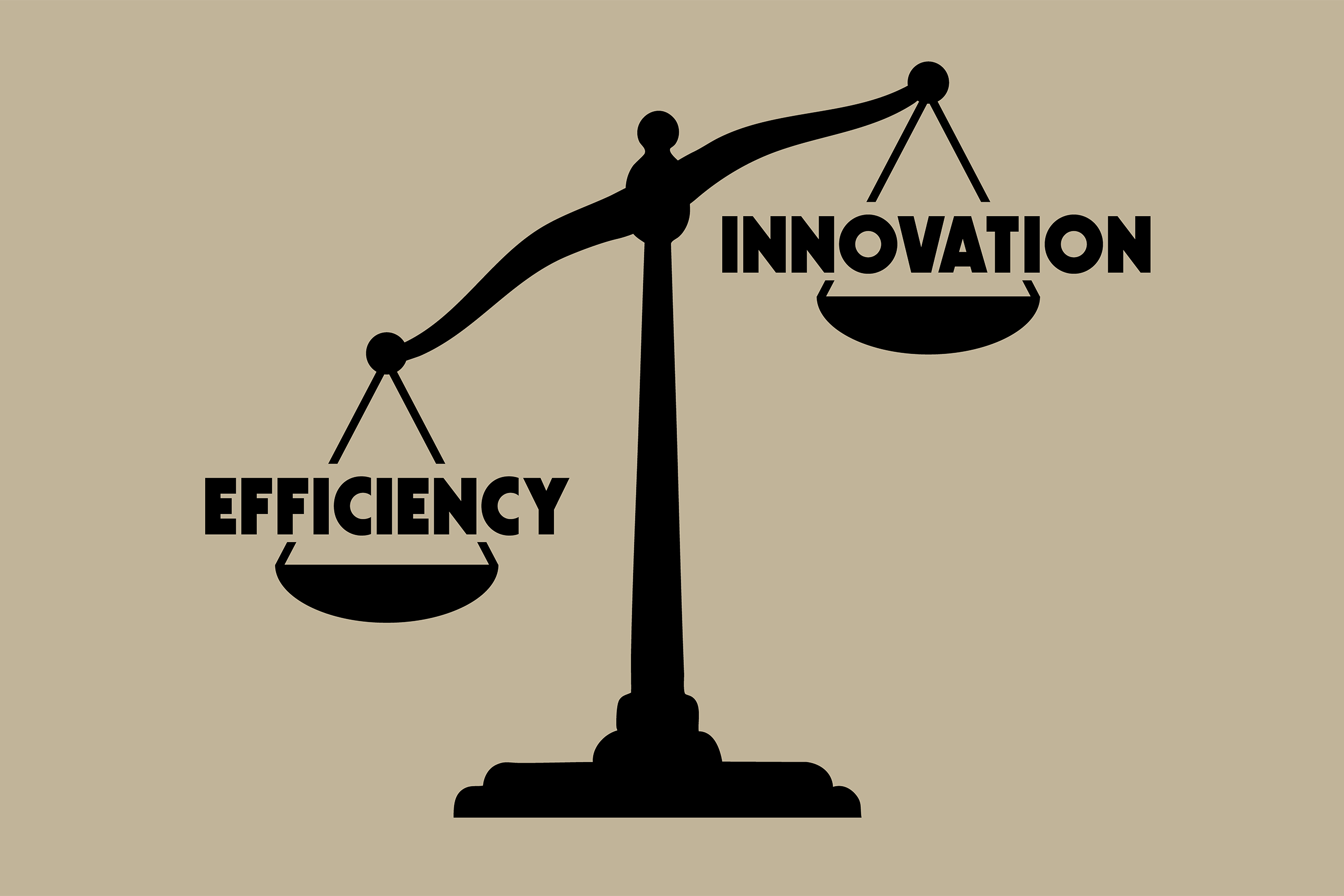
Author Blair Enns has coined something he calls the innoficiency principle—a spectrum where innovation and efficiency sit on opposite ends. They are opposable objectives and if you move toward one, you move away from the other. Large agencies, hungry for shareholder-approved margins, have swung the pendulum hard toward efficiency.
You can see it in the KPIs they optimize for and the ‘engagement’ they pay for.
You can feel it in the bureaucratic layers between client and creator.
You can hear it in the homogenous slop that floods our brainspace in the hopes that they win through sheer repetition, contrition and exhaustion.
Clearly, respecting the importance of efficiency with our client’s time and budget has been critical to how we’ve built trust over the last 15 years. But at some point, the operational machine becomes so refined that innovation gets squeezed out entirely. The agency is no longer built to explore; it’s built to replicate.
Mix it in with a landscape quickly saturated by AI-generated content—all of that algorithmic, automated, infinite sameness—the race to the middle is a death sentence.
What Breaks When Agencies and Studios Get Too Big
In almost every new business conversation that we have with prospective clients who have large agency experience, we hear a very common complaint of the sad state of affairs:
“The work lately feels less connected.”
“The relationship feels less like a true partnership and more like a transaction.”
“The people who really understood our brand are gone.”
When an agency becomes a financial asset, the client becomes a line item. The relationship is suddenly meaningful only “in dollar amounts.” And for brands navigating complex markets, that simply isn’t enough.
Large agencies can no longer see the big picture—because the big picture is too inefficient. Deep relationships? Way too laborious. Strategy and creative built from immersion? Too expensive. End-to-end coherence? Too messy across 14 departments and a holding-company roster.
The irony is that these “inefficiencies” are exactly what creates work that moves culture.
Where Small Agencies Win
So here is where smaller, independent agencies or studios will gain an advantage.
They can be inefficient on purpose.
They can think weird, move fast, and build the kind of trust that bureaucracies can’t operationalize.
They can build end-to-end in-house—keeping fidelity, context, and story intact from concept to final deliverable.
And most importantly: they actually care. I talk a lot about this. Being an owner-led shop means the responsibility to cultivate and invest in meaningful relationships is in our DNA.
For us, our client success isn’t just about making showable work. It’s really about our survival, reputation, and pride. It’s meaning.
Clients feel that—they want connection. Consumers feel that—they want experiences. And increasingly, the market will reward that.
AI Is Accelerating the Collapse of the Middle
Unfortunately, holding companies were already drifting away from championing experience and connections and towards commoditization. Now AI just shoved them over the cliff.
Generative AI democratizes production. It automates “good enough” work and accelerates the bland. The middle—where big agencies and media companies have planted their flag—is now more crowded, more automated, and more indistinguishable than ever.
Small agencies and studios, by contrast, can run in the opposite direction. They can position themselves as the weird ones. The human ones. The ones directly reachable, directly accountable, and directly invested in the outcome.
Ironically, AI makes the inefficiency principle even more powerful: the more automated the market becomes, the more valuable creative inefficiency becomes.
The Future Belongs to the Boldest Agency, Not the Biggest Shop
We really shouldn’t be asking, “How do we compete with Omnicom?”
The real question is, “Why the hell would we want to?”
Your playing field isn’t efficiency. You will never win a better-margins war against a conglomerate.
Your playing field is meaning.
Relationship.
Risk.
Coherence.
Story.
Taste.
Humanity.
Positioning means saying no maybe more frequently than you’re comfortable with. It means defining who you’re for, and fighting to not dilute it. It means building a perspective so clear and so unapologetic that scale becomes irrelevant.
Omnicom’s cuts and Netlix’ takeover is bad news for the people and industry caught in the middle. But there is good news for those who want to buck the trend, those who still believe in craft, and embrace inefficiency where it matters.
The Death of the Middle Is the Rebirth of the Creative Agency
Because we can do these things the giants can’t:
Take risks.
Tell real stories.
Build real relationships.
Make things that actually move people.
Own the entire process without losing the message.
And stay small enough to allow for the weird.
The creative industry isn’t dying.
The middle is.
That’s why I’m bullish on small, independent shops being the best thing to happen to creativity in decades.